Digital Marketing

4 Minutes Read

Published on 23 Jun 2026 | Updated on 25 Jun 2026

Questions to Ask a Branding Agency in Dubai Before You Sign Anything

Copy Link
Facebook
Twitter
LinkedIn
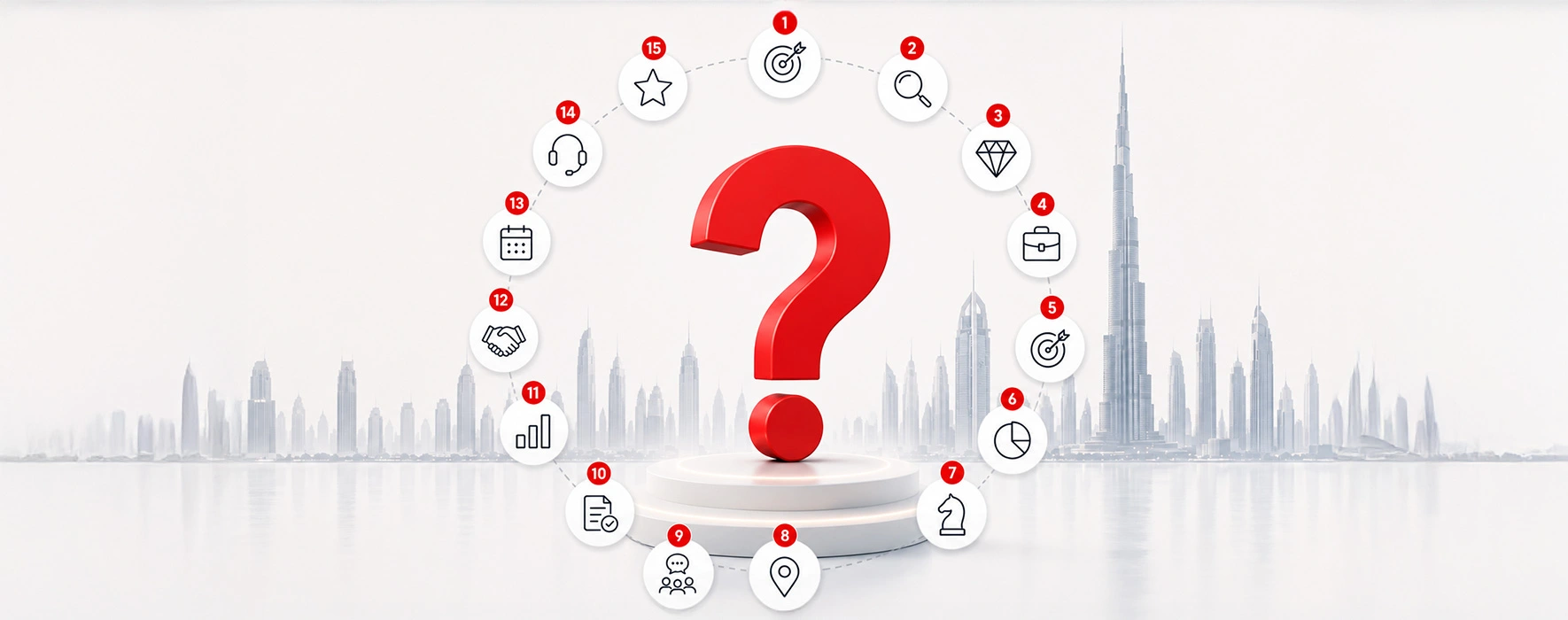
15 Questions to Ask a Branding Agency in Dubai

Table of Contents


Most branding agencies in Dubai are very good at one thing: their own brand. Their credentials deck is polished, their case studies look compelling, and their process slides are professionally designed. What those materials rarely reveal is how they think, how they handle a difficult brief, or what happens when a project encounters complexity.

The questions that reveal real depth come from the client side, not the agency. A well-prepared agency will walk you through impressive work and a confident process narrative. What it will not volunteer - unless you ask directly - is how it approaches a brief where the client's instincts and the market evidence point in different directions, or what it considers its weakest area, or who will actually be sitting at the desk working on your account.

The UAE branding market ranges from boutique identity studios to large full-service agencies. Quality, strategic depth, and commercial capability vary enormously and are not always reflected in portfolio aesthetics. This article sets out the questions that every business in Dubai should ask a branding agency before signing an agreement.

Before the Questions: What You Should Know About the Dubai Branding Market
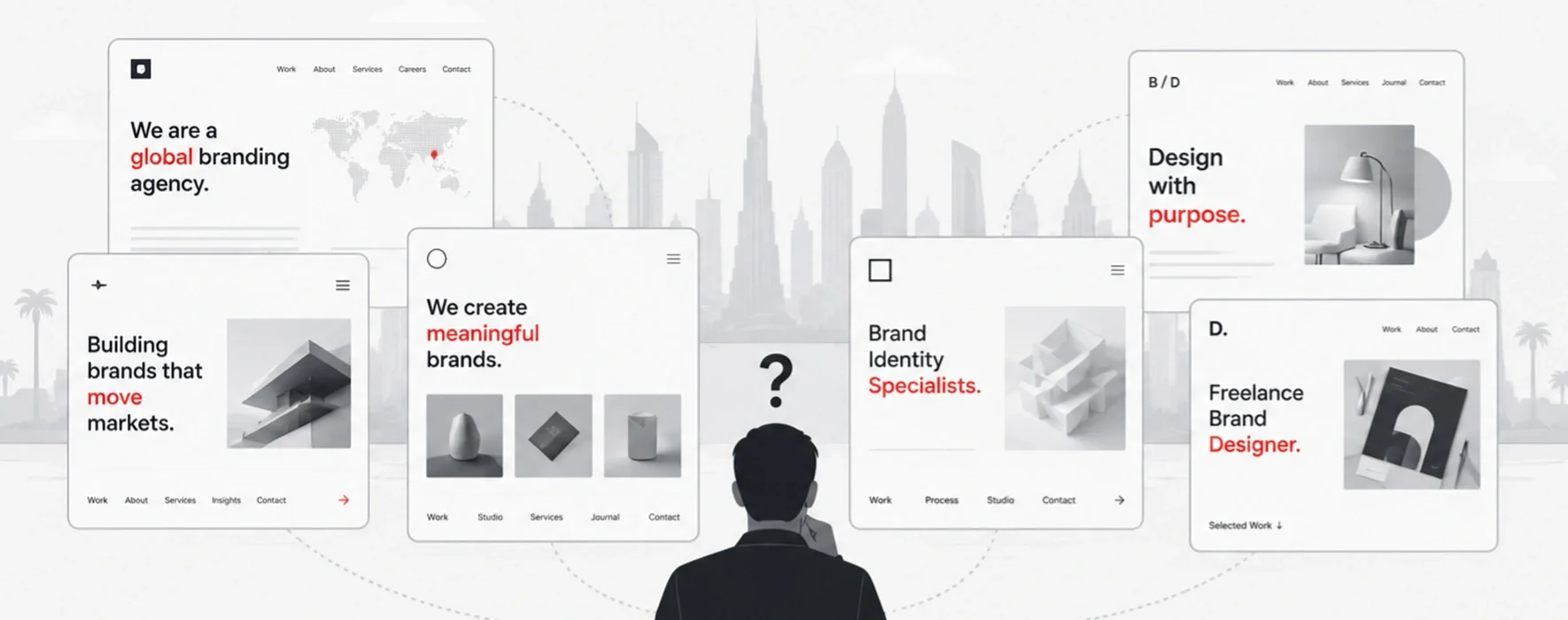

Dubai's branding agency landscape is one of the most competitive and fragmented in the MENA region. Global network agencies, regional independents, specialist identity studios, and one-person design practices all present credibly online. Visual quality across the market is generally high. That makes it harder, not easier, to evaluate what you are actually buying.

The Portfolio Problem

Almost every agency's website shows its strongest two or three projects. That selection tells you very little about average delivery quality, process reliability, or what the working relationship actually looks like when a project encounters revision cycles, scope changes, or a client who is uncertain about the direction. Ask to see work that is representative, not curated. Ask to speak to a client whose project did not go entirely smoothly.

Cultural and Sector Fluency Matters

The UAE is a multi-cultural, multi-sector market. An agency's genuine understanding of Arabic-language brand expression, Gulf cultural norms, and specific sector dynamics - built environment, hospitality, financial services, retail - is a substantive capability difference. It is not a nice-to-have. An agency that has never built a bilingual brand system for a UAE audience, or that outsources Arabic adaptation as an afterthought, is a different proposition from one that treats it as a core discipline.

The Strategy-Design Split

Some agencies lead with brand strategy and use design to express it. Others are strong visual executors who apply a light strategy layer to justify the design work. Some do both well. Most do not. These are genuinely different service offerings that produce different results. Knowing which you need before you walk into a briefing room is essential — and asking directly about how the agency splits its time between strategy work and design execution will tell you a great deal.

15 Questions to Ask a Branding Agency in Dubai


These questions are designed to move past the credentials presentation and into the strategic and operational depth that determines whether a branding engagement will deliver real business value. Use them before a briefing, during a pitch meeting, or when evaluating a proposal.

Strategy and Process

  1. How do you approach brand strategy before moving to visual identity?

    What to look for: A clear, described distinction between brand positioning work and design execution. Agencies that move to logo concepts in the first meeting without completing a strategy phase rarely deliver durable brand platforms. If the answer is vague or conflates the two, push further.

  2. Can you walk me through how you developed the positioning for a client in a competitive or crowded market?

    What to look for: A specific, named example with a described thinking process. Not a generic answer about workshops and research. A strong agency can explain the commercial problem, the insight that unlocked the positioning, and how that thinking translated into the identity.

  3. How do you handle a brief where the client's perception of their brand differs significantly from how their market actually sees them?

    What to look for: Evidence of the ability to have difficult client conversations and the confidence to ground recommendations in research rather than client preference. This is one of the most revealing questions you can ask — and the answer tells you whether the agency acts as a strategic partner or a service provider.

  4. What research do you conduct into the competitive landscape and target audience before beginning brand development?

    What to look for: A defined research methodology, not just a reference to discovery workshops. Competitive mapping, audience interviews, and sector analysis should be described specifically. In the UAE context, this should include Arabic-language competitor review and cultural audience profiling where relevant.

  5. How do you ensure that a brand identity will work across all the channels and formats the business actually uses — digital, print, Arabic and English, and out-of-home?

    What to look for: Evidence of multi-format and bilingual brand system thinking. Arabic adaptation is a substantive design and linguistic discipline, not a translation exercise. An agency that treats it as a secondary deliverable has not built many brand systems for the UAE market.

Experience and Credentials

  1. Which projects in your portfolio are you least satisfied with — and why?

    What to look for: Self-awareness and the ability to reflect honestly on work that did not reach its potential. Agencies that claim all projects are exemplary are either not being truthful or have not worked on projects with real complexity. Both are concerns.

  2. Have you worked with businesses in our sector before, and what were the specific challenges you encountered?

    What to look for: Genuine sector-specific knowledge, not surface familiarity. A Dubai real estate brand has different audiences, regulatory constraints, and communication norms than a professional services firm in DIFC. If the agency cannot describe the nuances, the sector experience is superficial.

  3. How do you balance the aesthetic preferences of the client with what the brand strategy actually requires?

    What to look for: A process that keeps strategy as the decision-making framework, not client taste alone. The answer should describe how the agency handles disagreement between what a client finds attractive and what the brand positioning requires. A strong agency has a method for this. A weak one just agrees.

  4. Can you provide a reference from a client whose brand you developed two or more years ago, so we can assess how the work has held up?

    What to look for: Willingness to provide live client references, and evidence that the brand has remained relevant and performed commercially over time. A brand that looked good at launch and has since been quietly replaced is not a success story.

  5. Who specifically will be working on our project — and will those people be in the room today?

    What to look for: Senior talent on the brief from day one, not a bait-and-switch to junior teams after signing. This is one of the most common grievances about larger Dubai agencies. If the people presenting the credentials are not the people doing the work, you need to know that before you sign.

Commercial and Practical

  1. How do you measure the success of a branding project?

    What to look for: Commercial and behavioural metrics, not just aesthetic measures. A brand that does not perform commercially is a design project, not a business investment. The agency should be able to describe how it tracks whether the brand is working — in terms of audience recognition, commercial conversion, or market positioning shift.

  2. What happens if the brand identity we develop needs significant adjustment six months after launch?

    What to look for: A clear policy on revision scope, whether post-launch support is included, and how change is handled contractually. Vague answers here often lead to difficult conversations later. The best agencies build a post-launch review into the project structure as standard.

  3. What is included in the brand guidelines deliverable, and what level of detail does it go to?

    What to look for: Comprehensive brand system documentation covering digital and print applications, Arabic and English expressions, social media, motion guidelines, and tone of voice. A single-page logo usage guide is not brand guidelines. It is a starting point. In the UAE, bilingual guidelines that treat Arabic brand expression with equal rigour to English are the professional standard.

  4. Can you describe a project that ran over time or over budget — and how you managed it with the client?

    What to look for: Honesty, clear communication under pressure, and evidence of project management maturity. Every agency of any size has experienced a project that did not run smoothly. What matters is how they handled it and what they learned. An agency that claims this has never happened has not done enough work.

  5. Why should we choose you over the other agencies we are speaking with?

    What to look for: A specific, differentiated answer that goes beyond passion and experience. Agencies that cannot articulate their own differentiation clearly and specifically have not done the strategic thinking they are being asked to do for your brand. The answer to this question tells you as much about the agency's strategic capability as anything else in the meeting.

Red Flags: What Should Concern You in the Briefing Room


As important as what an agency says in a briefing is what it reveals without intending to. These are the behaviours and responses that should prompt serious caution before you progress any further.

They present a creative concept before understanding your business objectives. Design without strategy is decoration. An agency that arrives with visual ideas before asking about your market, your audience, or your commercial goals has told you something important about how it works.

They cannot describe a project outcome in commercial terms. If the strongest thing they can say about a rebrand they delivered is that it looks great, that is a signal. A professional branding engagement should be able to point to measurable outcomes: improved market recognition, stronger conversion, clearer positioning against competitors.

They cannot name the specific team members who will work on your project. Credentials decks feature senior talent. The work is often done by juniors. Ask directly, and if the answer is evasive, ask again.

They do not ask probing questions about your target audience, competitive context, or business goals during the meeting. An agency that is not genuinely curious about your business cannot build an effective brand for it. Curiosity in the briefing room is a reliable indicator of how the agency will approach the actual work.

Their case studies show polished visuals with no business results or client outcomes described. Beautiful work with no evidence of commercial impact is not proof of effectiveness. It is proof of design capability. That is necessary but not sufficient.

They are unwilling or unable to provide a current client reference. This is a basic professional standard. Reluctance to provide references is a significant concern, regardless of the reason given.

None of these red flags automatically means an agency is the wrong choice. They do mean you need to ask more questions and review more evidence before signing anything.

What the Right Branding Agency in Dubai Should Be Able to Tell You


A strong branding agency does not wait to be asked the right questions. It demonstrates strategic depth, commercial awareness, and sector knowledge from the first conversation. If you find yourself having to drag information out of an agency in the briefing room, that dynamic rarely improves once a project begins.

A genuinely strong agency should proactively demonstrate the following, without being prompted:

A clear point of view on your sector and competitive landscape before the briefing ends — not a promise to research it later.

Named examples of how their work has delivered commercial outcomes for clients in comparable contexts, with enough specificity to be verifiable.

A transparent description of their actual process, including what they do not do well and where they would recommend a different approach or a specialist partner.

Honest acknowledgement of the limits of their capability — agencies that claim to do everything equally well rarely do any of it exceptionally.

Genuine interest in your business goals, not just the visual design brief — the questions they ask you in the meeting are as revealing as the answers they give.

Global Surf Perspective

At GS Digital, we approach branding as an integrated discipline — strategy first, identity second, digital performance always. We work with UAE businesses across professional services, built environment, real estate, B2B & industrial, and education sectors. If you would like to understand how we approach a branding brief and whether we are the right fit for your project, the conversation starts with exactly the kind of questions in this article.

Frequently Asked Questions

1. How much does branding cost in Dubai?

image

2. How long does a branding project take in Dubai?

image

3. What is the difference between brand strategy and brand identity?

image

4. Do branding agencies in Dubai handle Arabic brand adaptation?

image

5. Should I hire a local Dubai branding agency or an international one?

image

6. What should brand guidelines include?

image

Ready to grow your business in Dubai's digital market?

GS Digital works with UAE businesses across SEO, paid media, social, and full-funnel strategy. Get a free audit — no commitment required.

Clutch verified agencyGoogle PartnerMicrosoft Advertising Partner