SEO

6 Minutes Read

Published on 03 Jul 2026 | Updated on 24 Jul 2026

Why Construction Company Websites Need Case Studies, Not Just Service Pages

Copy Link
Facebook
Twitter
LinkedIn
Why Construction Company Websites Need Case Studies, Not Just Service Pages

Table of Contents


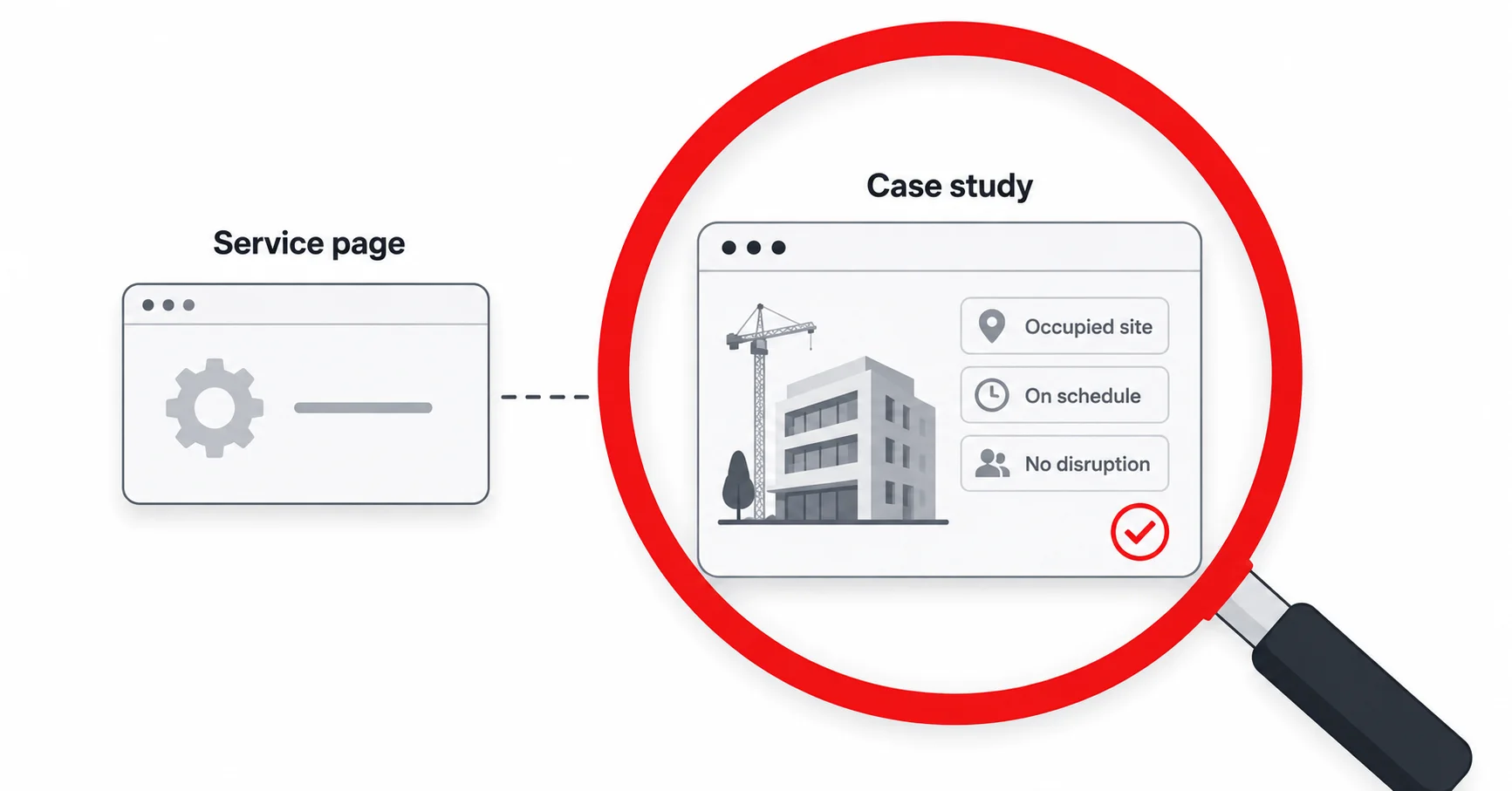
Construction buyers shortlist on proof, not promises, so a construction company website needs case studies, not only service pages. A service page tells a buyer what you do. A case study shows them you have already done it, on a project like theirs. Both matter, and the half most companies leave thin is the proof.

Picture a procurement lead with six contractor tabs open. Every site lists the same services in much the same words. The firm that makes the shortlist is usually the one that also shows the work, in detail, on a comparable project. This piece covers what service pages and case studies each do in construction company marketing, why buyers rely on both, and how to build case studies that carry the proof a service page cannot.


What a Service Page Does Well, and Where It Stops

A service page does one job well: it states what you do. It tells a search engine your service, captures the people looking for it, and gives a buyer the basic facts. Every construction company website needs strong service pages. They are the foundation, not the problem.

What a service page cannot do, on its own, is prove anything. Most read much the same across the sector. "We deliver high-quality fit-out solutions on time and on budget" could sit on any contractor's site in Dubai. Swap the logo and nothing changes. A description says what you offer. It does not show that you delivered it.


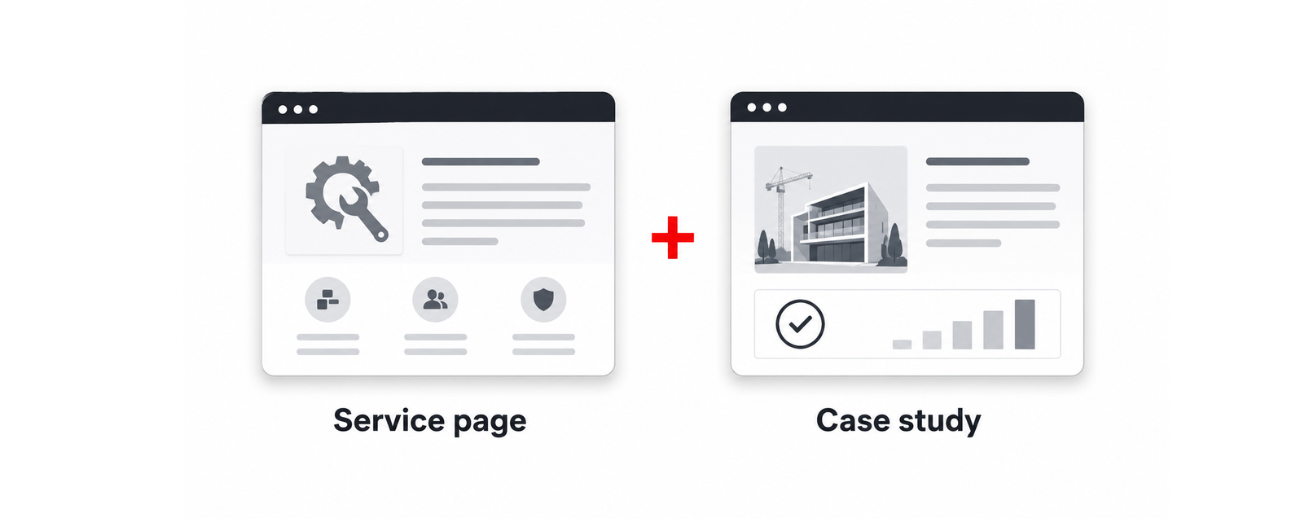
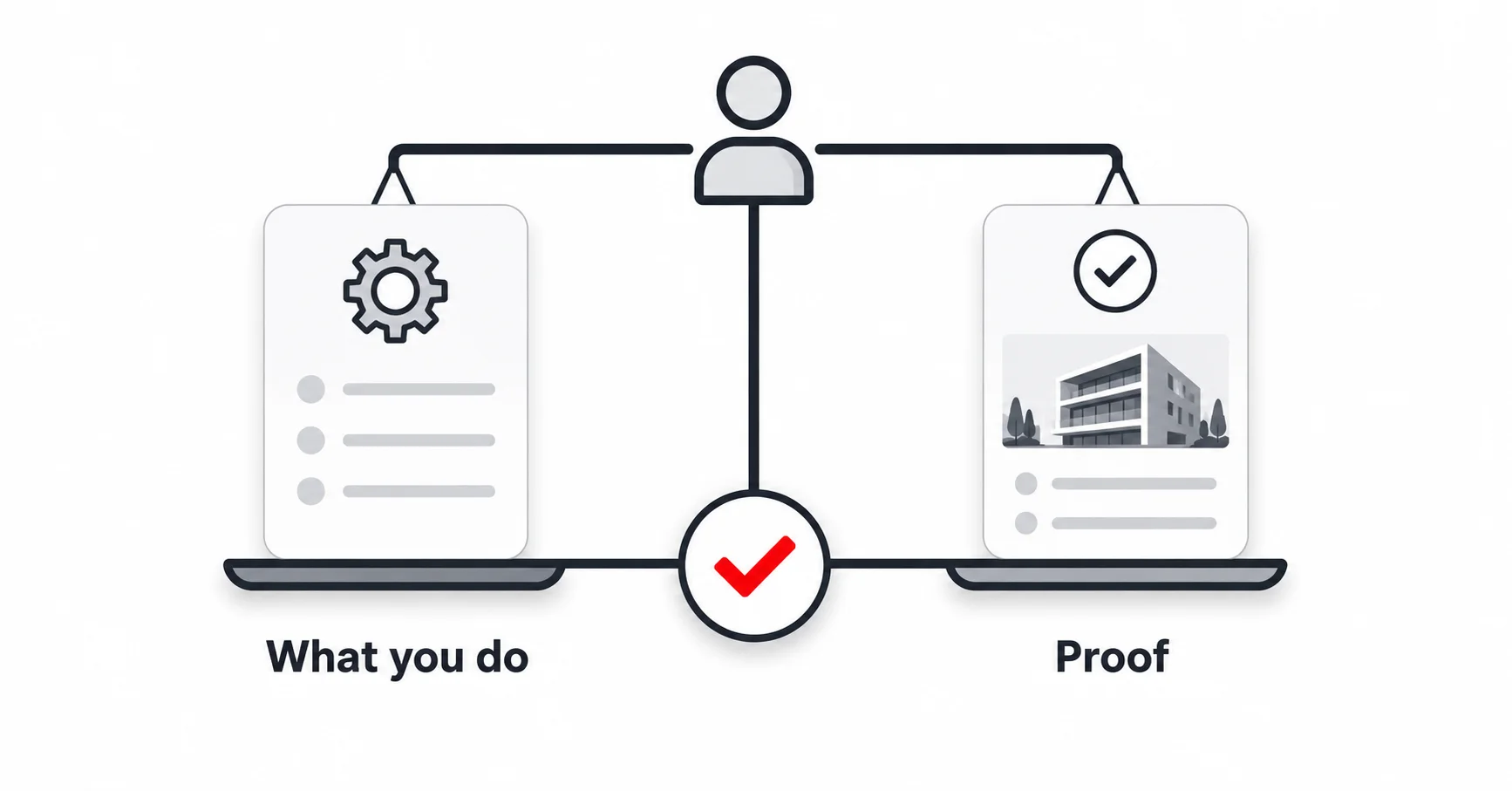
A service page and a case study answer two different questions: what you do, and whether you have done it. A construction buyer asks both.


So the choice is not a service page or case study. It is a clear service page plus the proof that backs it up. That proof is the job of the case study, and it is the part most sites skip.
 

What Construction Buyers Look For Before They Commit

What Construction Buyers Look For Before They Commit

Construction is a high-risk purchase. The wrong contractor can mean blown budgets, missed handovers, and a project that becomes someone's problem to explain upward. So alongside what you offer, the buyer weighs whether you can deliver it on a project like theirs without the job going wrong.

That is why they hunt for evidence. The procurement officer, the developer, the consultant building a shortlist all want the same thing: similar projects, comparable scale, the same sector or site conditions, a result that held up. Gartner's B2B buying research describes a distinct "validation" stage, where buyers move from thinking they know the right answer to needing to be sure of it before they commit. A case study exists to answer exactly that.

None of this makes the service page redundant. It makes the case study its natural partner. The service page opens the door. The proof keeps the buyer in the room.


What a Case Study Adds That a Service Page Cannot

Specificity is what a case study brings. A service page speaks in general terms because it has to cover every client. A case study names the real situation: the brief, the constraint, the site, the deadline, the outcome. That detail is exactly what a buyer uses to picture you on their own project.

Consider the difference. A service page says "we handle complex MEP installations." A case study says the team delivered MEP for a live, occupied building in Business Bay, worked around an operating tenant, and finished without disrupting them. One states the capability. The other shows it, in a scenario the buyer recognises, because it looks like the problem on their own desk.

That recognition moves decisions. A case study answers the validation question head on: yes, we have done this, here is the proof, here is what it took. Gartner's B2B buying research also finds buyers are 1.8 times more likely to reach a high-quality deal when they use a supplier's digital content alongside its sales team, rather than evaluating alone. Strong case studies are part of that digital layer. Digital marketing for construction companies works best when service pages and case studies do this job together, before anyone picks up the phone.


The Search and AI Advantage of Case Studies

Case studies are not only a trust asset. They are one of the strongest, and most overlooked, sources of search visibility a construction company website has.

The reason is unique content. Service pages target the core service terms, and they should. But every competitor targets those same broad terms, which makes them hard to rank and easy to blur together. Case studies create specific, original pages: a project type, a sector, a district, a challenge solved. Those match the long-tail searches real buyers make, where competition is thinner and intent is higher. This is where construction SEO quietly compounds. Every genuine project adds another rankable page that sits alongside the service pages, not instead of them.

The same logic now applies to AI answer engines. Tools like ChatGPT and Perplexity cite content that reads as authoritative and specific, not general. A detailed project story, with real constraints and real outcomes, signals genuine experience in a way a short service description cannot. For B2B SEO for construction companies, that specificity is the asset. General content is everywhere, and it earns nothing.


What Makes a Construction Case Study Actually Work

What Makes a Construction Case Study Actually Work

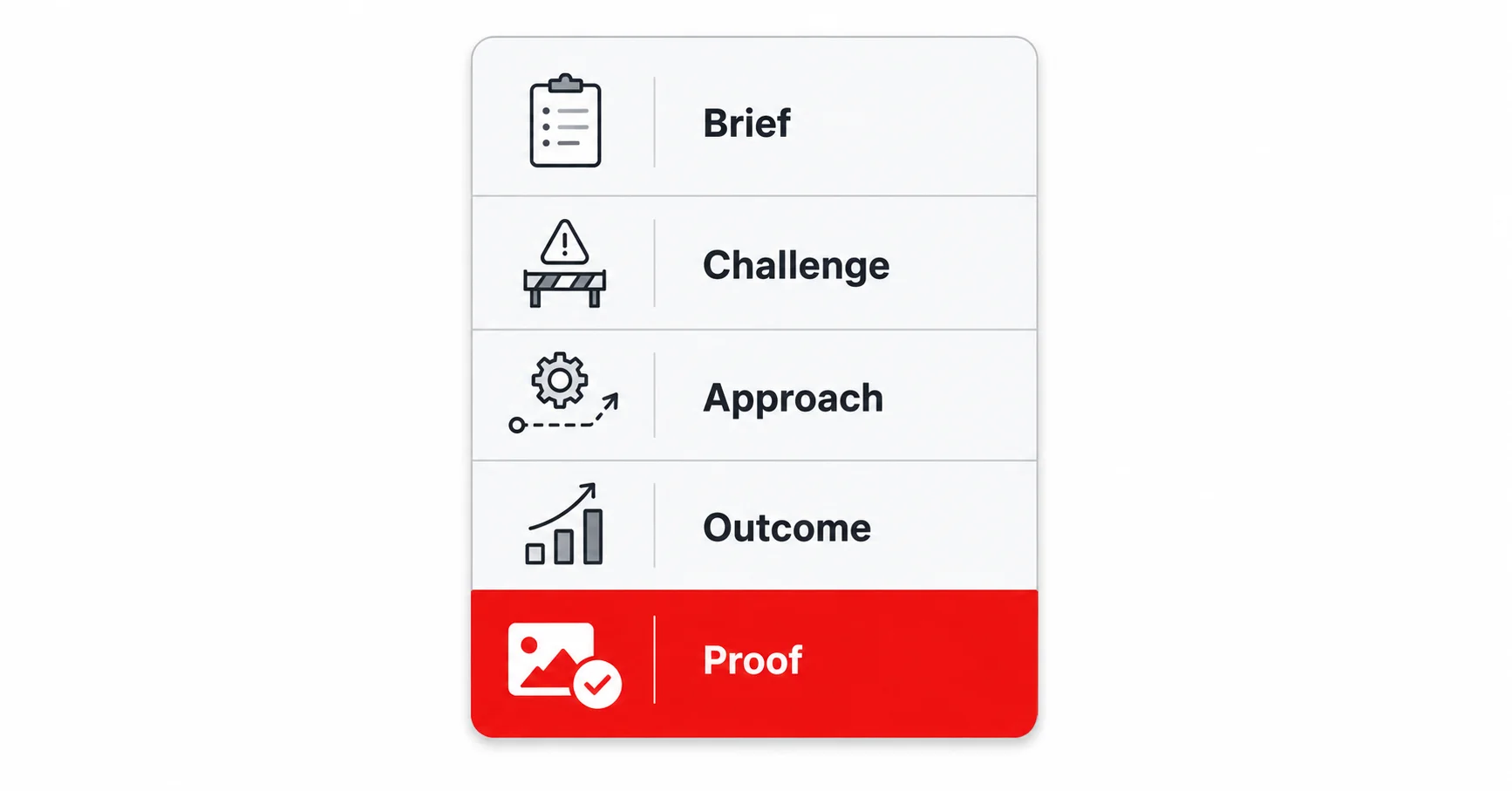
A weak case study reads like a brochure. A strong one reads like evidence. The difference is structure and honesty, not length or polish. A case study that earns trust usually covers five things clearly.

1.      The client and the brief. Who they were, the sector, and what they needed delivered. Anonymise where confidentiality requires it, but keep the scenario concrete.

2.      The constraint or challenge. The hard part. A tight handover, a difficult site, a phased occupied building, a demanding specification. This is what makes the story credible.

3.      What you actually did. The approach and the decisions, in plain terms. Enough that a buyer understands how you work, without a play-by-play.

4.      The measurable outcome. Delivered on schedule, to specification, the result in numbers where you have them. Specific numbers say more than adjectives.

5.      The proof. Project photos, figures, certifications, a client reference. Evidence the buyer can see.

Get those five right and a case study does more than describe a job. It becomes one of the most persuasive and most findable pages on the site, working alongside your service pages rather than replacing them. This is the part of contractor marketing that compounds, because every completed project is content a competitor cannot copy.


What We See Across Our Construction Accounts

Across the construction and contracting accounts we run at GS Digital, the pattern holds: specific, project-led pages keep people reading, and broad catch-all pages do not.

One design and build contractor we work with in the UAE shows it clearly. The page built around a single, specific type of project recorded an average engagement time of more than eight minutes in one month, the highest of any page on the site. The broad page covering several services at once held visitors for only a few seconds over the same period. The traffic reached both pages. Only the specific, project-led one gave people a reason to stay.

This is not an argument against service pages. It shows what proof-led content adds on top of them. Effective construction company marketing uses both: clear service pages for what you do, and case studies for what you have delivered.


Frequently Asked Questions

1. Are case studies more important than service pages in construction marketing?

image

2. Should construction companies stop building service pages?

image

3. Do case studies actually help with SEO for construction companies?

image

4. How many case studies does a construction company website need?

image

5. What is the most common mistake in construction case studies?

image

Build Better Leads With Stronger Construction Marketing

Working on the search visibility and content behind your construction company marketing? GS Digital is a digital marketing agency in Dubai that works with built environment brands across the UAE on SEO, content, and lead generation. If your service pages are solid but your projects are doing no work on the site, we can show you where the gap is.

image
Aravind JS

Digital Marketing Strategist | Global Surf Digital

Aravind JS is a Digital Marketing Strategist with over 12 years of experience building and scaling digital presence for luxury brands, automotive clients, and B2B businesses across the Middle East and beyond.

Clutch verified agencyGoogle PartnerMicrosoft Advertising Partner